Sunday, June 24, 2018

Will Nike Deliver on Its Promises Next Week?

Nike�(NYSE:NKE) has been telling investors for the past several quarters that it was building toward a rebound in its core U.S. market. You had to squint to see evidence of that shifting trend in its last few quarterly reports, but management's comments in late March made it clear that this long-anticipated recovery had just started.

As a result, Nike is expected to reveal solid sales and profitability numbers in its quarterly report on Thursday, June 28. Let's examine exactly what investors will be looking for in this announcement.

A jogger ties his red sneakers.

Image source: Getty Images.

Sales and profits in the U.S.

Nike generates more than half of its sales from outside of the United States, but its home market is still important to overall revenue and profit trends. The segment has been pressured for close to two years as customers shifted their shopping habits online and forced retailers to use price cuts to work through a big inventory buildup.

The most recent results didn't show that sales trend reversing. In fact, revenue was down 6% in the U.S. last quarter, compared to a 5% drop in the prior quarter. However, Nike lessened its reliance on price cuts, which allowed gross profit margin to fall by just 0.7 percentage points. That result beat management's forecast and also marked a solid improvement over the prior quarter's 1.2-percentage-point drop.

The bigger news was management's shifting tone toward more optimism about the U.S market. Back in December executives said they were hoping the segment might begin to stabilize soon. By March, the comments were much brighter. "We now see a significant reversal of trend in North America," CEO Mark Parker said in late March.

As a result, investors are looking for the U.S. market to show roughly flat sales results in the context of improving gross profit margin trends on Thursday.

International gains

Nike's bigger international footprint has helped protect its earnings from the type of collapse that rival Under Armour�has endured. The Chinese market in particular is important for investors to watch, since management has staked a large portion of its future growth on that division.

While the sports apparel industry niche in the U.S. is projected to hold steady at about 50 million people, China's should soar to 10 times that total over the next few years. That's a key reason why Nike believes it can expand sales there in the low to mid-teen percentage range between now and 2022. Parker is likely to spend plenty of time on Thursday talking about demand trends there, which recently showed healthy growth of almost 20%. �

The new fiscal year

Executives suggested back in March that Nike's new fiscal year would bring broad improvements to the business. Sales growth is likely to return to positive territory in the U.S. in fiscal 2019, they said, and faster gains in international markets should also support what they called "strong" growth in profitability.

Nike didn't issue specific numbers to back up those general forecasts, and so investors have had to hold tight until the fiscal fourth-quarter announcement for their first look at the company's 2019 outlook. Positive earnings reports over the last few weeks, both from rivals and from retailing partners, have suggested that this prediction might include robust sales and profit growth. But now it's up to Nike to deliver on the optimism it has helped build on Wall Street over the past few months.

Wednesday, June 20, 2018

5 High-Yield Dividend Stocks To Watch

With oil prices improving over the past year, the energy sector has been a hotbed of merger and acquisition activity. These transactions and those to come will likely have a big impact on the high-yield payouts of midstream companies in the sector. Because of that, the following five high-yield stocks stand out as those to watch closely since they all have what could potentially be a payout-altering catalyst on the horizon.
It's not a matter of if but when

On Energy Transfer Equity's (NYSE:ETE) first-quarter conference call, the company's management team provided investors with a unique glimpse of what's going on behind the scenes. One of the things they're working on is the acquisition of namesake MLP Energy Transfer Partners. CEO Kelcy Warren said on the call that the companies have "looked at every scenario possible to us" and that the only one that makes mathematical sense is for Energy Transfer Equity to buy its MLP. That transaction would not only simplify the company's corporate structure but could enable Energy Transfer to resume growing its 7.1% yielding distribution.

Waiting for the dust to settle
Earlier this year, natural gas giant EQT Corp. announced a series of moves to streamline its midstream business, including selling the rest of its midstream assets to its MLP, EQT Midstream Partners (NYSE:EQM), and merging its other MLP, Rice Midstream Partners, into EQT Midstream. The scale and complexity of these transactions have weighed on EQT Midstream, which has shed nearly 25% of its value since the start of the year. However, once the dust settles on these transactions, EQT Midstream could have significant upside since the company believes it can grow its 7.7%-yielding payout at a 15% to 20% annual rate through 2020.

Looking for more clarity
This past February, Antero Midstream Partners (NYSE:AM) announced the formation of a special committee of its board of directors to evaluate transactions that the company might take to improve its valuation. Among the options it could potentially consider is merging with its parent, Antero Midstream GP; a full spinoff from its producing partner Antero Resources; or even merging with another midstream company. The uncertainty about what the company plans to do is currently clouding its outlook, making it unclear if it will continue on the current path to increase its 5.1%-yielding distribution at a torrid pace over the next few years.

Waiting for the first one to drop
Last fall, big oil giant BP completed the IPO of its MLP, BP Midstream Partners (NYSE:BPMP). BP seeded the company with several pipelines, which positioned it to increase its 5.1%-yielding payout at a 5% to 6% annual pace through 2020. However, BP Midstream has the potential to grow at a much faster rate by acquiring additional midstream assets from its parent. The two companies hope to complete their first dropdown transaction later this year, which could accelerate BP Midstream's distribution growth rate up to a mid-teens annual pace over the next few years. That upcoming catalyst makes BP Midstream worth watching since the size of the acquisition should give investors a better idea of how much the company could grow its distribution in the coming years.

An interesting catalyst to monitor
MPLX (NYSE:MPLX) currently expects to increase its 7.1%-yielding distribution by 10% this year. Furthermore, the MLP has $2.2 billion of expansion projects underway, which should fuel it to keep growing the payout in the future. However, an interesting catalyst developed earlier in the year when MPLX's parent company, refining giant Marathon Petroleum, agreed to buy fellow refiner Andeavor. What makes that deal interesting to MPLX is that Andeavor owns several midstream assets as well as a stake in MLP Andeavor Logistics. It seems highly likely that Marathon will eventually sell those midstream assets to MPLX as well as merge the two MLPs. Those transactions have the potential to move the needle for MPLX, which is what makes it a compelling company to watch.

This article originally appeared on The Motley Fool.

Tuesday, June 19, 2018

A dangerous dot-com era phenomenon could wipe out profits, Jim Paulsen warns

A new research note warns that too many investors are stuck in a losing trade reminiscent of the dot-com era.

The Leuthold Group's Jim Paulsen is behind the ominous call.

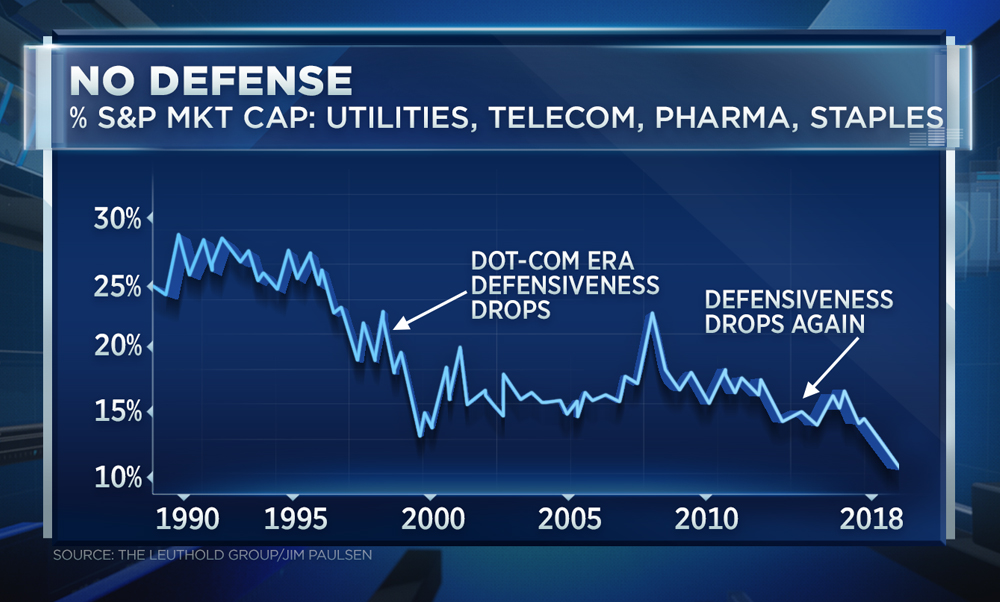
"More and more of the leadership stocks have been the more aggressive, high beta stocks and a lot of the defensive names have been left for dead. They've diminished as far as their size of the overall [S&P 500] index," the firm's chief investment strategist said Monday on CNBC's "Trading Nation."

Paulsen hasn't seen that phenomenon since the late 1990s when excitement surrounding dot-com stocks hit a fever pitch.

"I don't think it is nearly as severe as it was back then, but the culture is the same. The character is the same where everyone is going into the same, very narrow number of popular names," he said. "Really nobody is investing new moneys into the rest of the S&P."

He included a chart that shows a sharp decline in the number of people investing in S&P 500 defensive names since the bull market began in 2009 �� noting that defensiveness is at a record low.

According to Paulsen, many investors are too exposed to trendy areas of the market such as big tech FANG, otherwise known as Facebook, Amazon, Netflix and Google parent Alphabet.

"You wonder if we do hit an air pocket, if we would break below those February lows sometime this year, who do you think is going to sell? It's probably going to be those popular names because that's all anyone has recently bought," he said.

Paulsen, who estimates there's a 50-50 chance see a 15 percent sell-off this year, is urging investors who are overweight big tech to take some profits.

"Maybe to pat yourself on the back, congratulate yourself for a great investment," Paulsen said. "Maybe buy a beat-up consumer staple or utility here or pharma stock today that no one is taking a look at, but sells at a much better value."

Vote Vote to see results Total Votes:

Not a Scientific Survey. Results may not total 100% due to rounding.

show chapters No defense: Investors are fleeing safety stocks at an alarming rate No defense: Investors are fleeing safety stocks at an alarming rate    16 Hours Ago | 05:51 Disclaimer